We asked Gemma 4 to read 20 of our product pages. It cost under half a cent
Kishore Adobe Commerce Certified Professional 5 min read
Covers events from 20 November 2026.
We ran our new catalogue audit on magekwik.com with the judged checks on our own OpenRouter key and Google's Gemma 4 31B. 30 products read, 20 judged, 46 seconds, under half a US cent. What it found, what it could not judge, and why its answer sits beside the score and never in it.
Our catalogue audit reads a sample of a Magento store's product pages and counts what a shopper, a search engine and an AI assistant can find on them. Most of it is measured: markup, specifications, photos, policy pages. Some of it can only be read: does the copy answer what a buyer asks, does a claim come with terms, does the text agree with the specifications table. For those six checks the audit asks a model, on the store owner's own key. On 20 November we ran the whole thing on our own site, magekwik.com, with Google's Gemma 4 31B through OpenRouter, and kept a screenshot of every step.
Connecting a model, and testing it first
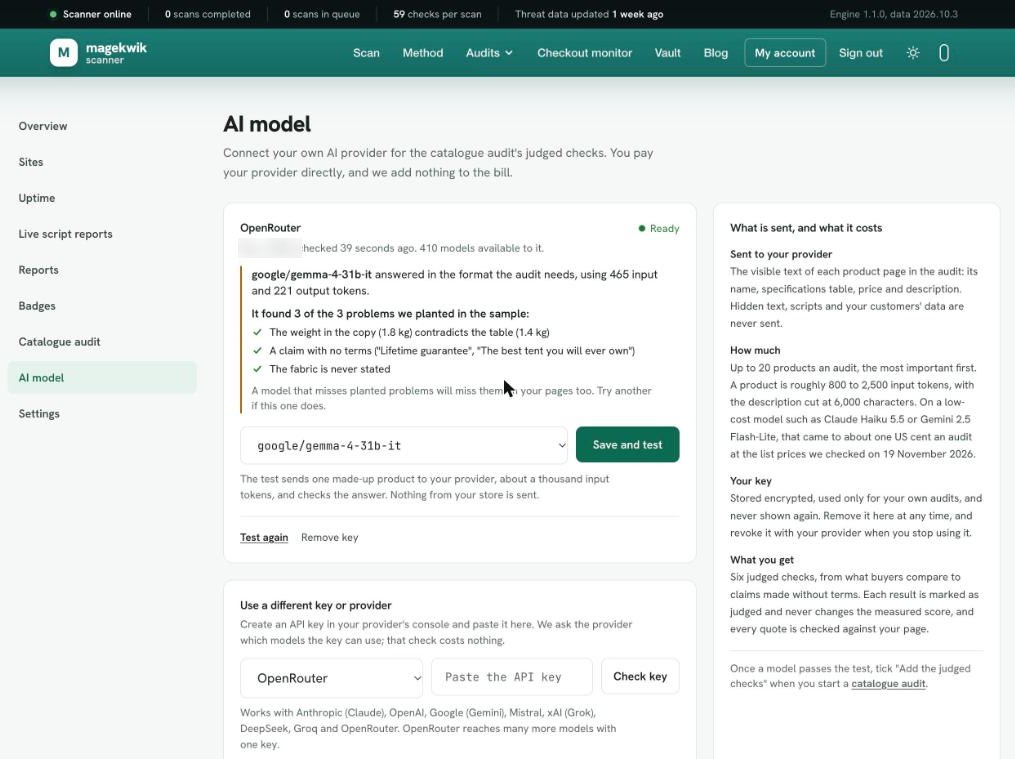
The key goes in on the AI model page. We ask the provider which models the key can use, which costs
nothing, and the key is stored encrypted and never shown again. OpenRouter listed 410 models for
ours. We picked google/gemma-4-31b-it, the larger of the two Gemma 4 models it offers.
Before a model is allowed near a store, it gets a test: one made-up product with three problems planted in it. The weight in the copy contradicts the table, a "lifetime guarantee" comes with no terms, and the fabric is never stated. A model that misses planted problems will miss them on real pages too. Gemma 4 found all three, using 465 input and 221 output tokens.
Starting the audit
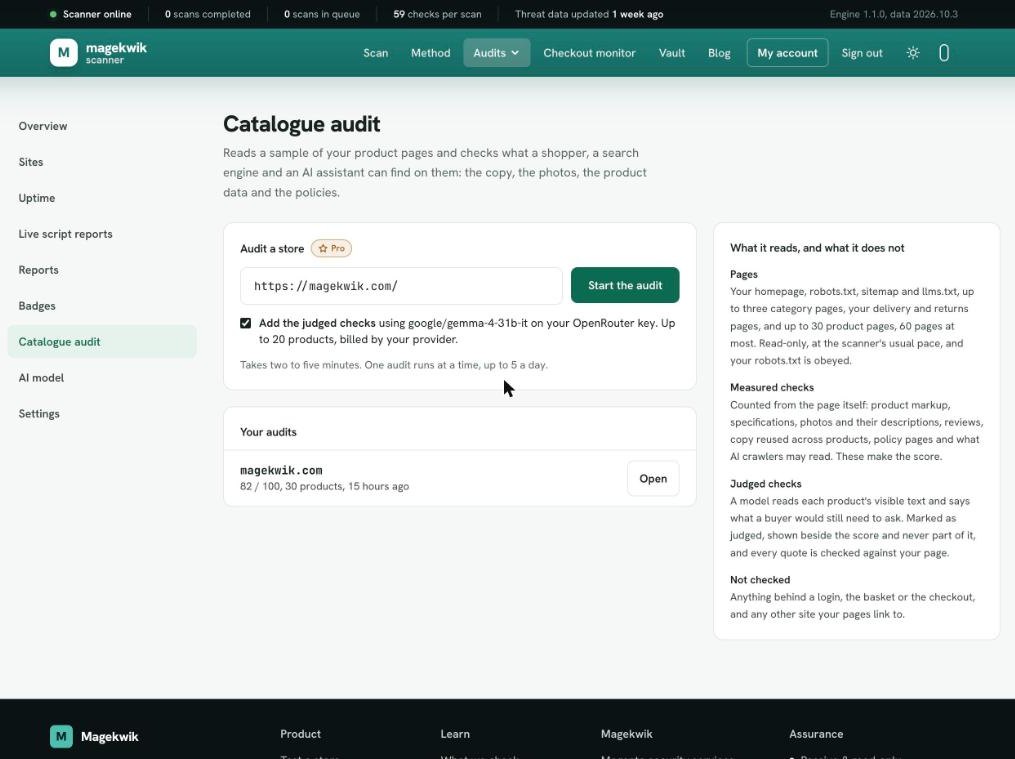
With a tested model, the catalogue audit offers one more tick box: add the judged checks. The audit names the model and the key it will use, and says the bill goes to the provider. We add nothing to it.
Watching it run
The audit runs in five steps, and the page shows each one as it happens: checking the store, finding
product pages, reading them, scoring, and asking the model. The crawler reads at the scanner's usual
pace, obeys robots.txt, and only makes GET requests. The model step makes no request to
the store at all: it reads the pages already fetched.
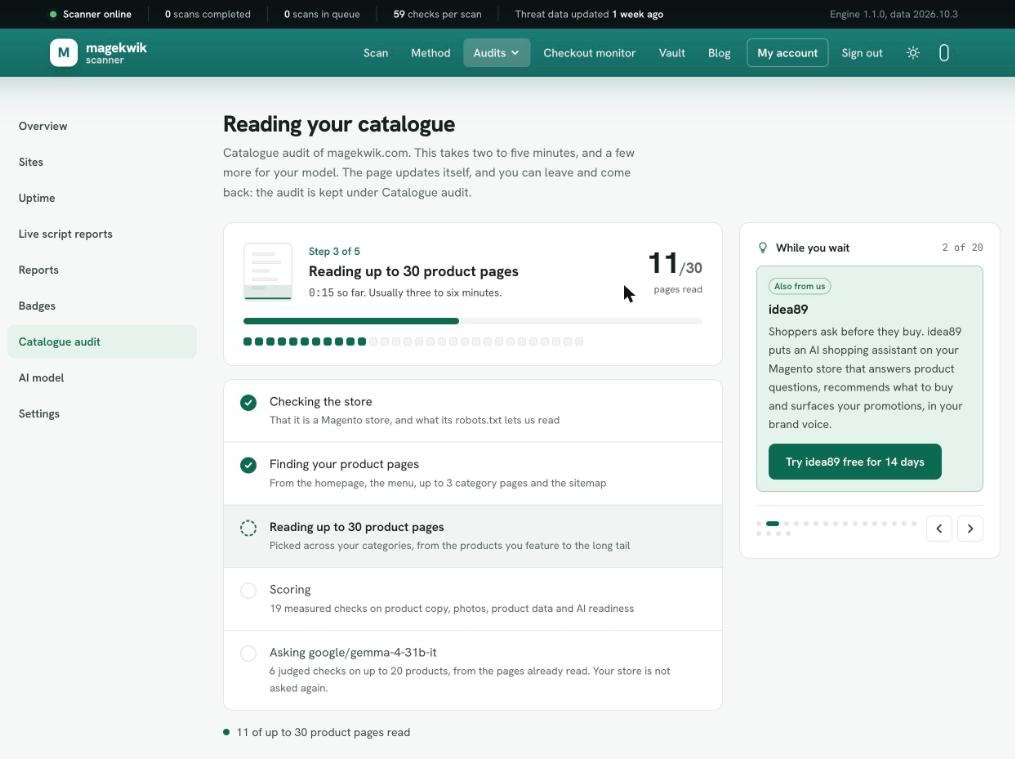
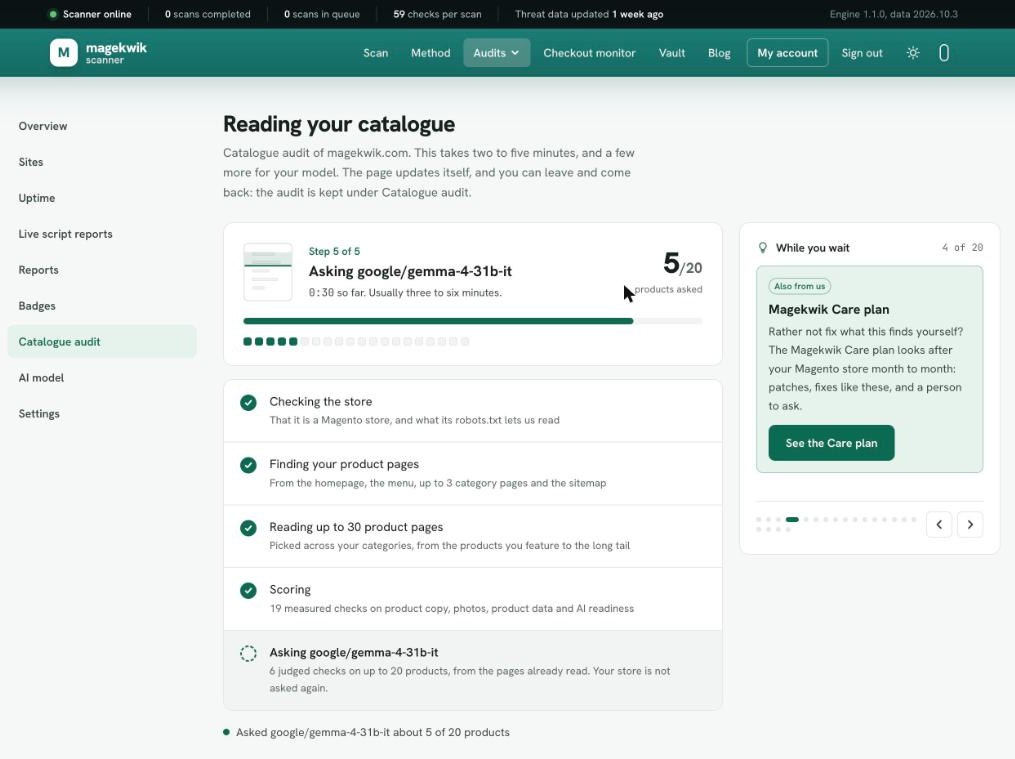
From start to finish it took 46 seconds: 44 pages read, 30 products sampled, 20 of them judged. magekwik.com is quick and small, so a larger store will take longer. The audit is capped at 60 pages and a few minutes either way.
The result
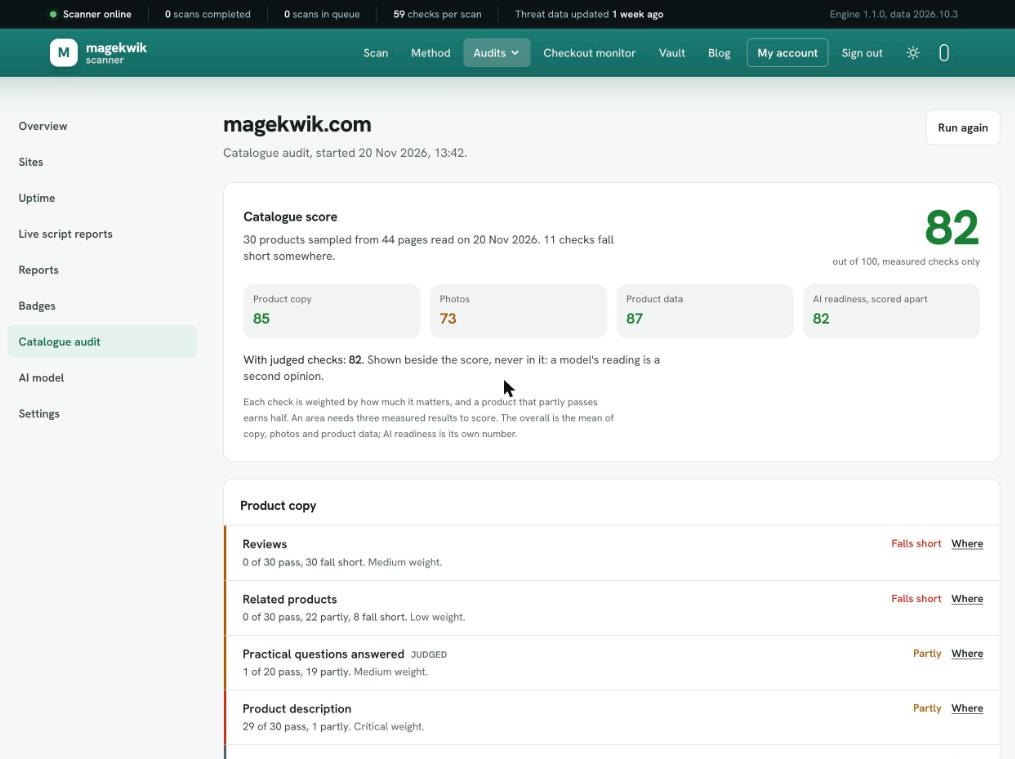
The catalogue score was 82: product copy 85, photos 73, product data 87, and AI readiness 82, which is scored apart. The judged checks put it at 82 too. That number is shown beside the score, never inside it, because a model's reading is a second opinion and we will not let one move a measured grade.
What the model found
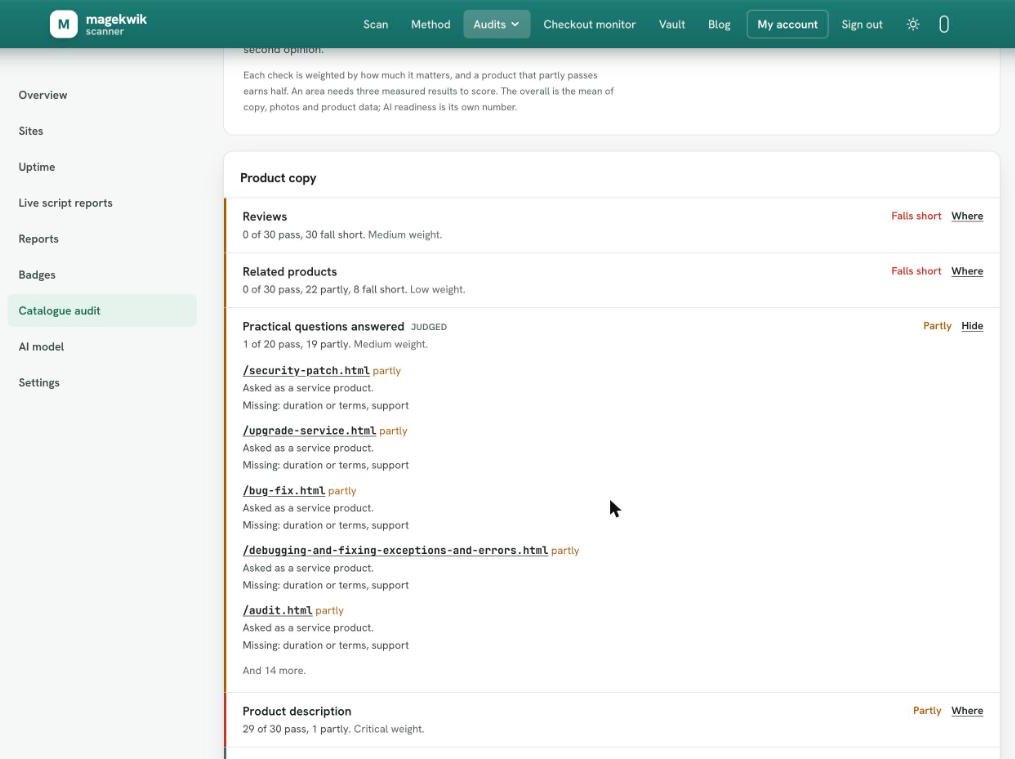
Four of the six judged checks gave an answer. Three passed on all 20 products: claims came with terms, the copy agreed with the product data, and spelling and grammar held up. The fourth, "practical questions answered", passed on 1 product and partly on 19. On our service pages (the security patch, the version upgrade, the bug fix, the audit) the model read them as services, and on each it could not find how long the work takes or what support comes with it.
That is a fair finding, and not one a measured check could make. Nothing in the markup says "this page never tells you how long it takes". A buyer notices, and now so does the report. Every judged row is labelled Judged and lists the pages and what was missing on each.
What it could not judge
Two checks came back "Not measured": whether the copy covers what buyers compare, and whether key facts sit in the specifications table. Both start from the specifications a store usually lists, and a services shop like ours lists none. The audit says so in one line instead of guessing. A store selling tents or tyres would get both.
What it cost
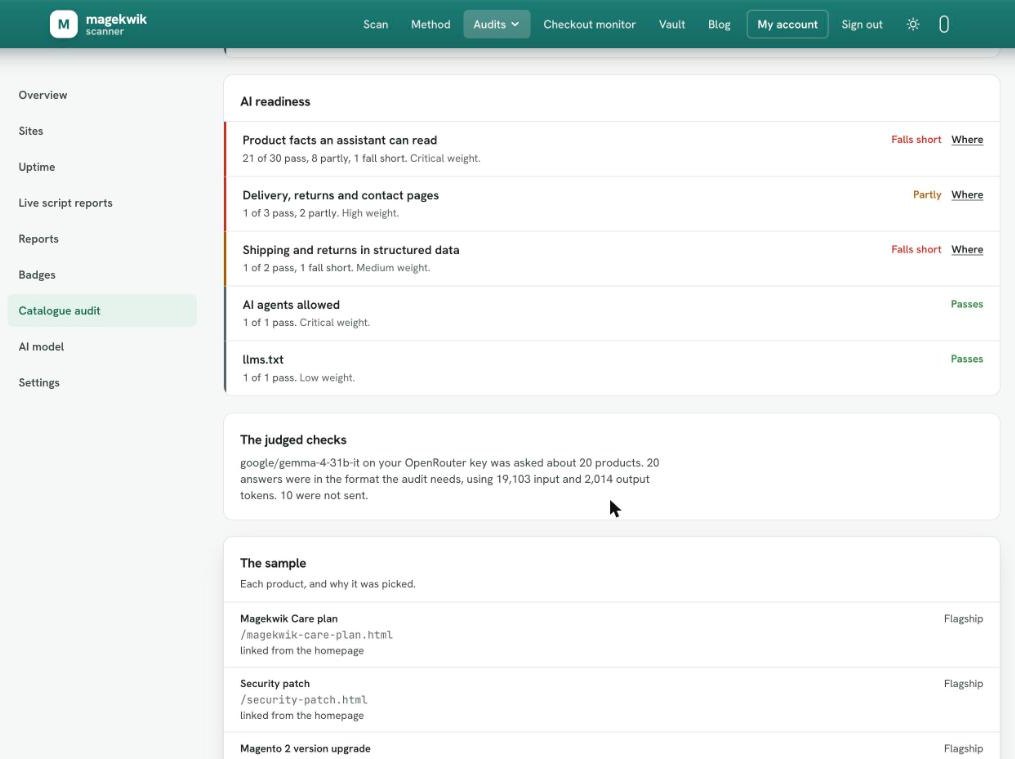
20 answers came back, all in the format the audit needs, for 19,103 input and 2,014 output tokens. At OpenRouter's list price for Gemma 4 31B on 20 November 2026 ($0.20 per million input tokens, $0.40 per million output) that is about $0.0046, under half a US cent, plus a fraction of that for the model test. Prices change, so check the model page before you rely on the number. The other 10 products in the sample were not sent: the judged checks stop at 20, so the cost has a ceiling.
Why the model never sets the grade
A model can be wrong, and two models can disagree. So the rules are fixed in the audit, not in the prompt. Only a product's visible text is sent: name, specifications, price and description, cut at 6,000 characters. Hidden text, scripts and your customers' data are never sent. Any quote the model gives is checked against the page, and an answer that does not fit the format reads "Not measured" with the reason. And the judged number stays beside the measured one, so the score you track week to week means the same thing whichever model you use.
Run it on your store
The catalogue audit is part of Scanner Pro, and the judged checks run on your own key with any of the providers on the AI model page: Anthropic, OpenAI, Google, Mistral, xAI, DeepSeek, Groq or OpenRouter. The free AI crawl runs the AI readiness checks on their own, with only an email and no key.
References & sources
Primary sources: advisories, vendor research and the CVE record. Verify against these rather than against us.